
By Mark Small
In a 1967 hit song, Roger McGuinn of the Byrds rock band sang:
So you want to be a rock ‘n’ roll star?
Then listen now to what I say.
Just get an electric guitar,
Then take some time,
And learn how to play.
And with your hair swung right,
And your pants too tight,
It’s gonna be all right.
The song was a satirical oversimplification even when it was written. Today, those wanting to pursue a career in popular music can take a more systematic approach with the help of colleges and universities with outstanding contemporary music programs.
While there are over 2,000 four-year colleges and universities in America, only about a dozen grant degrees in popular music studies. He adds that there are quite a few “pretenders” and suggests students keep two things in mind when assessing if a school has a true curriculum for contemporary music.
The first thing to consider is the types of ensembles it offers. The second is whether they offer songwriting. Many schools say they have a commercial music program, but their ensembles are primarily jazz bands. As for the second point, it’s hard to make the case for a pop music program if there are no songwriting classes. Songwriting is central to popular music.
Below, we will look at five institutions with celebrated popular music studies programs that do meet these two criteria. At the end of the post, we follow it up with a list of notable programs at other institutions.
5 Colleges Popular Music Majors Should Consider
University of Southern California
The Thornton School of Music at USC has all-star faculty drawn from respected names in music. The overarching contemporary music program includes a range of areas for study in popular music, jazz, the music industry, music technology, musical theatre, popular music, screen scoring, and studio guitar. USC’s popular music department is within the Contemporary Music division. Founded by Christopher Sampson in 2009, it is chaired by composer, keyboardist, and four-time Grammy nominee Patrice Rushen.
USC’s popular music degree track embraces rock, R&B, pop, folk, Latin, and country styles. It emphasizes musical skills and the nuances of styles. Undergrads take classes in performance, songwriting and arranging, recording studio techniques, MIDI programming, music production, and entrepreneurship in addition to core courses in music theory, ear training, music history. Electives in contemporary music culture, film music, world music, and general education courses are also among degree requirements.
Located in Los Angeles, USC enjoys a roster of faculty who are veteran composers, performers, and producers with impressive credentials. Among them are guitarist Paul Jackson Jr., bassist Alphonso Johnson, drummer Will Kennedy, pop music violinist Ginny Luke, songwriter Andrea Stolpe, and multi-instrumentalist and vocalist Adriana Balic. The department strives to foster a creative and collaborative environment for students.
At the nexus of America’s music, movie, and TV industries, USC is near major concert venues, record industry headquarters, famous recording studios, and more. The proximity offers many extra-curricular learning experiences and employment opportunities. Admission to USC’s Thornton School of Music is competitive, with about a 20 percent acceptance rate. The popular music program has the reputation of being even more competitive.
Belmont University
In 1979, Belmont University’s College of Music and Performing Arts became the first in the nation to offer a Bachelor of Music degree in commercial music. The course of study includes commercial music, music technology, and performance, but also embraces traditional offerings in classical, church music, music education, and more.
The program is built on a foundation of classical music, jazz, and blues to inform student studies of contemporary forms. Those majoring in commercial music can choose from five areas of emphasis: performance, songwriting, composition and arranging, music business, and music technology.
Belmont actually fields a second college dedicated to various aspects of popular music. The second is the Mike Curb College of Entertainment and Music Business. Founded in 2003, it bears the name of a legendary performer, songwriter, producer, and record company executive. The Curb College offers courses in songwriting, audio engineering, media production, music business, journalism, publishing, and more. Look inside its buildings, and you will find top-notch studios and technology.
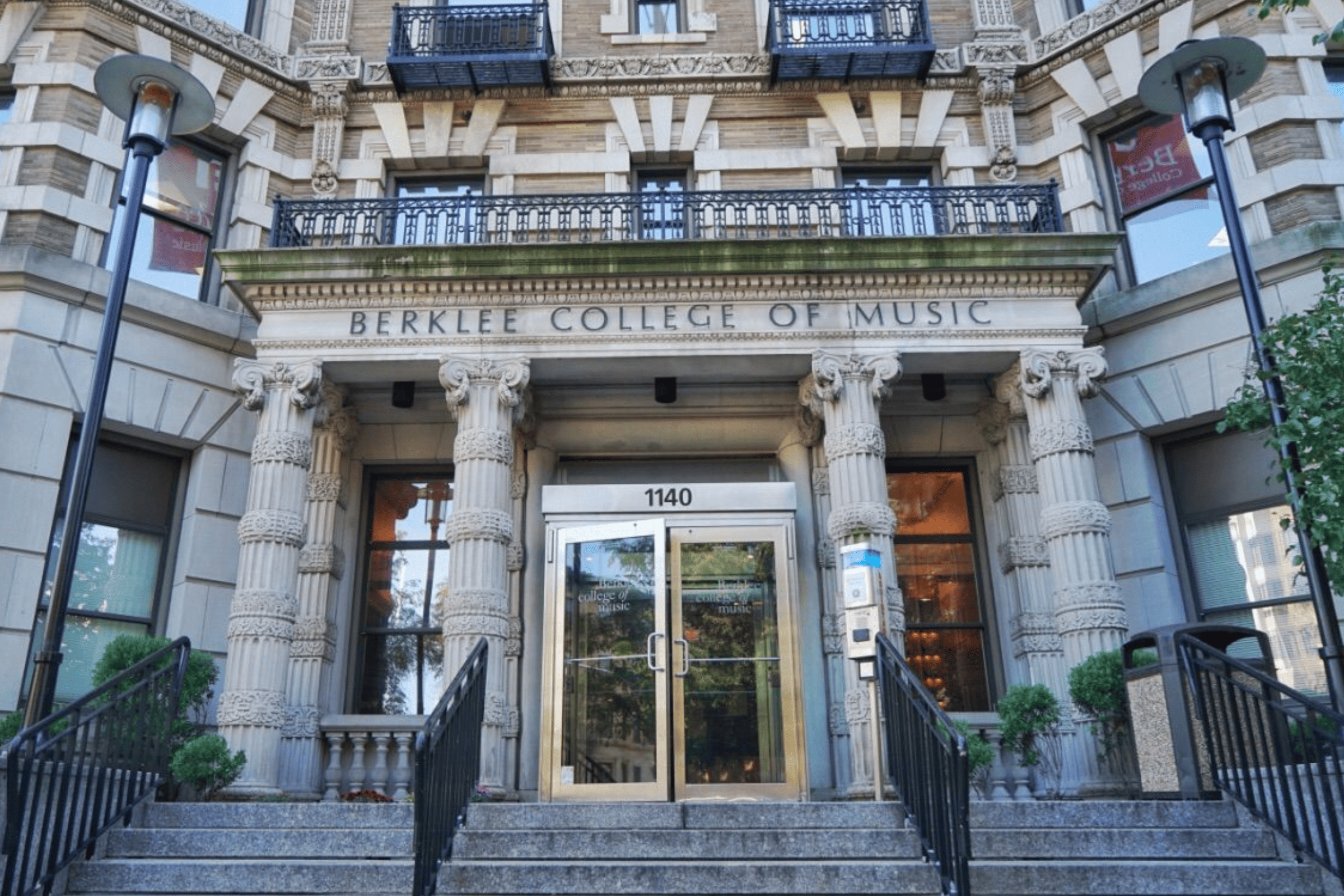
Berklee College of Music
The world’s largest institution for music studies is the combined Berklee College of Music and Boston Conservatory at Berklee. It ranks at or near the top of the list for best contemporary music colleges, with popular music being a key component in its expansive curriculum. Berklee grants undergraduate degrees in 12 majors and 30 principal instruments ranging from electric guitar, bass, and drums to orchestral instruments, banjo, electronic digital instruments, and more. For decades after its founding in 1945, Berklee was the only option for students to learn musical styles not taught at classical conservatories.
Berklee was the first school to offer studies in performance, composition and arranging for jazz musicians. Over the decades, it has burnished its outlier reputation by creating a very diverse curriculum. Berklee became the first institution in the nation to offer electric guitar as a principal instrument in 1962, a film scoring major in 1979, music synthesis studies in 1984, and songwriting in 1987. Further innovations included establishing an audio recording department (1977), music business major (1992), music therapy major (1996), hip-hop curriculum (1999), American roots music minor (2006), Africana musical studies (2006), video game scoring (2009), an institute for creative entrepreneurship (2014), and a popular music institute (2016).
University of Miami
The Frost School of Music at the University of Miami (Florida) offers an array of highly respected studies among its eight departments. In addition to instrumental and voice performance studies (which embrace classical music, opera, jazz, and popular styles), other departments focus on music education and therapy, theory and composition, studio music and jazz, musicology, and music media and industry.
Frost’s Modern Artist Development and Entrepreneurship program (M.A.D.E.) is a comprehensive program for those seeking a BM in popular music and music business. The program’s approach allows students to tailor their studies for the career they envision. The school’s motto reflects this emphasis: “Build Yourself at Frost.” The M.A.D.E. program is designed for the business-minded musician; honing one’s musical craft is but one component needed for success in today’s music industry. The curriculum covers performance, writing, arranging and orchestration, musical directing, marketing and promotion, copyright and licensing, creating business plans, and more.
M.A.D.E. students who want to delve deeply into performing and songwriting can pursue a minor in the Bruce Hornsby Creative American Music program (C.A.M.), named for an iconic singer-songwriter and UM alumnus. C.A.M. is open to all Frost music majors by audition.
New York University
Like Belmont, the study of popular music takes place within two areas within New York University (NYU). The Steinhardt School of Culture, Education, and Human Development, with its Music and Performing Arts Professions Department, offers an expansive curriculum. Areas of emphasis include instrumental performance studies for orchestral players (brass, woodwind, strings, and percussion) as well as vocal and jazz studies. NYU’s popular music track leads to a BM in Music Theory and Composition with a concentration in Contemporary Production and Songwriting.
In addition to typical undergraduate music courses in aural comprehension, music history, music theory, and general keyboard skills, popular music majors study songwriting, music technology, music publishing, contemporary scoring, orchestration, and jazz arranging. Songwriters receive input from accomplished faculty members and songwriting professionals and collaborate with classmates as lyricists and composers. Liberal arts courses round out the degree.
With a campus located in one of the world’s great cities—another music industry hub—and proximity to many cultural happenings, NYU is an excellent destination for those serious about a range of music careers. Acceptance into NYU is competitive at 16%.
Prepare for Your Next Step
The electric guitar and distinctive hairdo recommended by the Byrds may still have their place in rock stardom, but much has changed since 1967. Developing a multifaceted talent and gaining practical knowledge about the music industry at a college or university multiplies the options and increases the odds for developing a lasting career somewhere in the music business.
Additional Colleges and Universities with Strong Programs for Popular Music Majors
- Catawba College (Salisbury, NC)
- University of the Arts (Philadelphia, PA)
- Los Angeles College of Music
- Middle Tennessee State University
- Fullerton College (Fullerton, CA)
- Columbia College Chicago
- The City College of New York
Do you picture yourself in a music career?
If the answer to that is a “yes”, your next step is simple. Contact insidemusicschools.com and allow our team of industry insiders to guide you toward your goal of being a professional in the music industry. Through expert admissions counseling and real world experience, we will make sure you are prepared for the journey.
FAQs About Best Music Colleges for Popular Music Majors
Which colleges offer degrees in popular music?
Only a select number of schools offer true popular music degrees. Some of the top programs include USC, Berklee College of Music, Belmont University, University of Miami, and NYU. These schools provide specialized training in contemporary music and help students prepare for a professional music career.
Do I need to study songwriting to pursue a pop music degree?
Yes! Songwriting is a core part of most popular music programs. Learning how to write songs is essential for building a career in contemporary music, whether you want to perform, produce, or work in the music industry.
Can I focus on multiple music styles in college?
Absolutely. Many programs let you explore a variety of styles, including rock, pop, R&B, jazz, Latin, and more. You’ll also take courses in performance, recording, and music business, giving you a well-rounded foundation for a music career.
How competitive is admission to top popular music schools?
Admission can be very competitive. Schools like USC and NYU have acceptance rates under 20%, so it’s important to prepare strategically for auditions, prescreens, and portfolio submissions.
Is it better to choose a university or a conservatory for pop music?
It depends on your goals. Universities often provide broader academic and industry opportunities, while conservatories focus intensely on performance and technical skills. Your choice should align with your aspirations and the type of guidance you want during your studies.