
By Mark Small
How Advanced Study Can Open Doors Across Performance, Business, and Beyond
At a Glance
- Student: Lucy Geller
- Starting Point: Liberal arts undergrad (theater major, music + history minors)
- Key Decision: Pursue graduate music school instead of staying in a non-music career path
- Goal: Transition into a serious, multifaceted music career (performance, composition, teaching)
- Challenges:
- Unclear path
- Limited formal music training for professional pursuit
- Shifting focus from musical theater to interdisciplinary composition and contemporary music
- Outcome: Accepted to New England Conservatory’s Contemporary Musical Arts program
When your path isn’t linear, but you know music is part of it
Singer/composer Lucy Geller grew up in Eugene, Oregon, in a family that fostered the musical interests of both her and her older sister. “My parents are both lawyers, not musical,” she said in a recent phone conversation. “But my mom was a culture enthusiast in general. She used to check out old movie musicals from the library, and I loved them. I was not a Disney kid.” Lucy discovered her gift for singing early on, and by high school, she says she was a dedicated “choir kid” and active in the school’s robust musical theater productions.
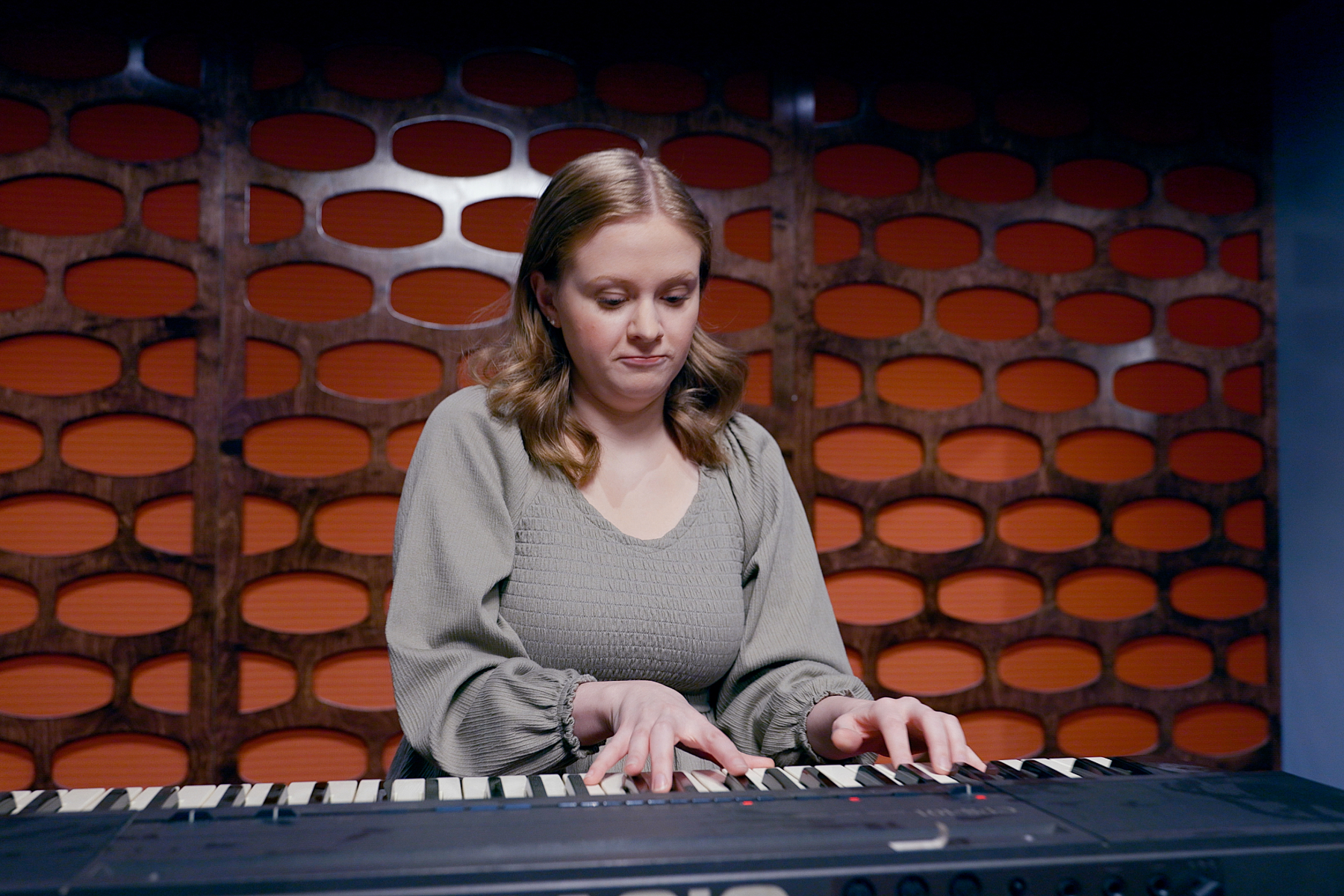
Choosing Breadth Before Specialization
Like others nearing their high school graduation, Lucy began weighing her options and considering colleges. She wanted a life in the arts and wondered whether to enter a musical theater program or attend a liberal arts college with a broader range of offerings. Ultimately, she chose Pomona College. “It’s a small liberal arts school that’s one of the Claremont Colleges in Southern California,” Lucy recalled. “I majored in theater and double-minored in music and history. It was a toss-up between those three areas.”
When Interests Evolve and New Strengths Emerge
As she progressed in her studies at Pomona, she found her desire to focus on musical theater waning. “I had more positive experiences in the choir and doing interdisciplinary things,” she says. “I began composing music for my music theory courses and really enjoyed that. I also wrote some short musicals and ended up producing one of them in my senior year.” Her college experience was interrupted by the COVID-19 shutdown, and Lucy had to work remotely online with student friends who could mix and edit video to produce her movie musical.
“I felt really isolated in college toward the end,” she shares. “We couldn’t live on campus, so it was like college without any of the fun stuff. I was a pandemic graduate and finished my studies from my childhood bedroom in Eugene.”
The Moment of Realization: “I Need More Training”
After receiving her degree, she began working in a corporate office as an executive assistant. This motivated her to look elsewhere for her future. “I felt my ambitions had shifted a little, and I wanted to go to music school because I didn’t have that opportunity as an undergrad,” she reveals. “I started teaching music and loved it, but felt unequipped to pursue music professionally. I needed to go back to school.” So, she began the search for the right grad school.
Not Classical. Not Jazz. So…Where Do You Fit?
Lucy’s challenge wasn’t just getting into a program. It was finding the right kind of program.
“I could have pursued classical voice if I’d had a year or two more to prepare,” she stated, “but I wasn’t interested in going into classical music exclusively. I wanted a different type of program, something interdisciplinary that didn’t have a specific genre. I was singing some jazz at the time, but didn’t have a lot of jazz experience. So, there were only a few programs that fit what I was interested in.”
Her interests were broader:
- Composition
- Interdisciplinary work
- Blending genres (folk, jazz, pop influences)
Programs that truly supported that flexibility?
Far fewer than you’d think.
Turning Options into a Strategy
Lucy and her family reached out to Inside Music Schools for counsel on which institution would best prepare her for the career she wanted. Steve Lipman and Karen Kerr at IMS provided Lucy with a list of schools offering programs that could help her attain her goals. The Contemporary Musical Arts program at Boston’s New England Conservatory (NEC) captured Lucy’s attention. “It was everything I wanted in a program, so that school became my top choice,” she shares. “Steve and Karen came up with a balanced school list for me in case I didn’t get accepted to NEC. I worked with them on preparing my materials and for the audition.”
The Audition Strategy That Changed Everything
IMS set up a mock audition and meetings with faculty members at the Frost School of Music at the University of Miami. Raina Murnak, director of Frost’s Summer Institute of Contemporary Songwriting, and Assistant Professor Daniel Strange conducted Lucy’s mock audition. Strange also gave her input on the score of one of her compositions. The most important guidance they gave was that she choose material with more stylistic contrast for her auditions.
“The two songs I picked for my mock audition were not different enough from each other,” Lucy admits. “I had an original song about climate change prepared for my pre-screen, and it sounded like musical theater. My other song was a jazz arrangement of ‘Far from the Home I Love’ from the musical Fiddler on the Roof. I used that one for my pre-screen at NEC because they asked me to write an arrangement of an existing piece that represented a significant transformation of the piece.” Lucy’s IMS advisors suggested she find something to replace her climate change song. She had been working with a friend on music for a short film that integrated the sounds of 12th-century mystic and composer Hildegard von Bingen with looping elements. She chose that to replace her original song because it was a definitive contrast to her jazz arrangement.
Lucy auditioned for both NEC and CalArts in Los Angeles. The latter offers a Master of Fine Arts degree for composers/performers. For the NEC audition, Lucy brought the chart she’d written for the rhythm section that would accompany her in her jazz arrangement, as well as a vocal amp and looping pedal for her second song. The NEC audition also required applicants to learn a saxophone solo from a Duke Ellington tune, sing it a cappella, and demonstrate their ability to improvise. It was a rigorous audition.
“With the input from IMS, I felt like I had picked things that represented me and showed a contrast,” she shared. “I left feeling good about what I’d done,” she says. “I think I was memorable and made an impression. It had been a long time since I did auditions for my undergrad college, so I was glad to have guidance from Karen and Steve.”
From Memorable Audition to Acceptance
Lucy’s auditions were indeed memorable; she received call-backs from both schools and committed to her first choice, NEC. She has greatly enjoyed her studies and friendships made with her NEC peers during the two-year program. She finds the coursework challenging. “There is a lot of arranging and composition in this major, but once you are doing it all the time, notating music gets a lot easier and faster,” she said. “In this program, you have to be able to read a score but also learn by ear because there are a lot of things in music that notation will not capture exactly.”
Designing a Career with Multiple Paths
Now nearing completion of her master’s degree at NEC, Lucy’s path is no longer uncertain—it’s expansive.
“I loved my program so much that I auditioned for the graduate certificate program,” she adds. “I’m not sure yet if I will commit. I’m currently applying for fellowships, grants, and residencies.”
Lucy is pondering various career options. Her interests include performing, teaching, and possibly further studies in ethnomusicology or historical musicology. She is at home singing in a range of genres, but ideally aspires to perform her original music: a blend of folk, pop, and jazz. Her ideal career would include performing and a professorship in higher education. For Lucy, earning her master’s degree represents attainment of a life-shaping goal. She will now begin writing the next chapter of her life.
The Bigger Takeaway: Clarity Changes Everything
Lucy’s journey reflects what many aspiring musicians experience: real talent paired with uncertainty about where it fits. When your interests span disciplines and your path isn’t clearly defined, the next step can feel overwhelming—or easy to delay.
What made the difference wasn’t just more training—it was clarity. With the right career guidance, Lucy was able to identify programs aligned with her goals, present herself with confidence, and take a decisive step forward. That shift—from uncertainty to direction—is often what turns potential into progress.
Mark Small
Mark Small, classical guitarist, composer, and music journalist, has spent the majority of his life in New England. He has composed classical, jazz, pop, and sacred music for chorus, wind ensemble, orchestra, piano, and guitar. He holds bachelor's and master's degrees in classical guitar performance from New England Conservatory and California State University, Fullerton. He also studied guitar and composition at Berklee College of Music, and served for 26 years as editor ofBerklee todaymagazine until his retirement in 2018.
An active music journalist, Mark has written forGuitar Player, DownBeat, Acoustic Guitar, Soundboard, Classical Guitar, and other music publications.