
By Michael Gaspari
Key Takeaway:
The right music school doesn’t just prepare you for one career. It creates opportunities for careers you haven’t discovered yet. Michael’s story shows how keeping doors open and having experienced guidance can lead to unexpected and rewarding paths in music.
A Life Built Around Music
When I was younger, I thought success in music meant choosing a single path and committing to it. What I eventually discovered was that the most meaningful opportunities often come from keeping doors open.
Music has shaped my life since I was five years old, and over the years it has led me down paths I never expected to pursue. Today, I am a composer, film scorer, arranger, producer, keyboardist, teacher, and entrepreneur. My journey has taken me from Juilliard Pre-College to Oberlin Conservatory and the University of Miami Frost School of Music, while also helping me build a career centered on creativity, accessibility, and education.
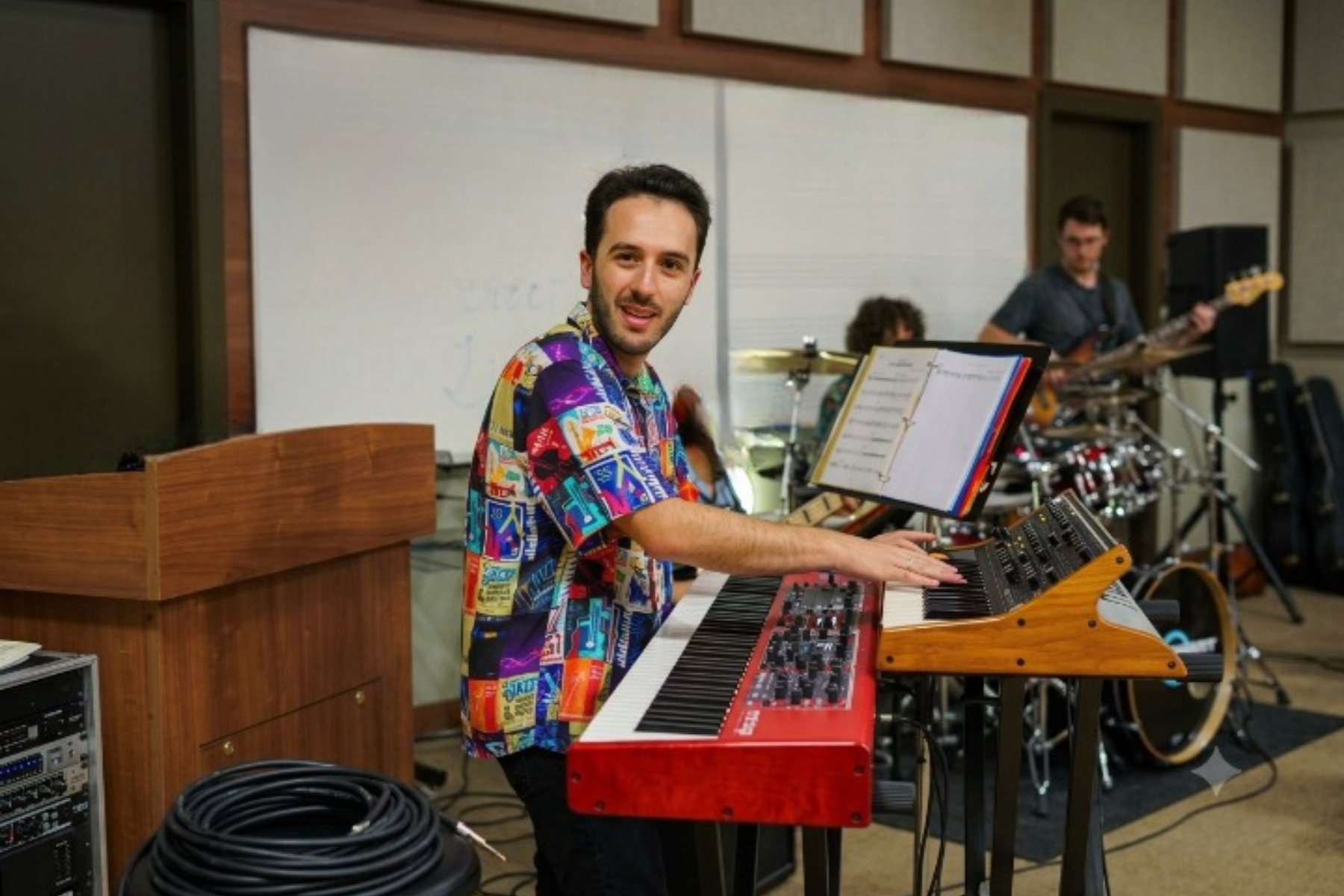
Looking back, one of the most important lessons I learned was through working with Steve Lipman at Inside Music Schools. I learned that finding your path isn’t always about choosing a destination. Sometimes it’s about discovering possibilities you didn’t know existed.
Using Stories as a Composer and Musician
Throughout my journey as a composer and musician, I have released four albums and two singles across a range of genres on streaming platforms. One of these is a concept album called “On the Bridge,” diving into my life growing up as an autistic person in a world not built for disabled people. My most recent release was a Christmas album consisting of a theme and variations of an original Christmas melody, sonically set in my personal interpretation of the holiday season in the early 2000’s.
I believe that there is a benefit to sharing deeply personal music with the world. I always strive to tell specific stories of my experiences through my music in a way that the vast majority of listeners can relate to. In addition, I have written music for film, TV, large ensembles, live electronics, installations, and electroacoustic spaces. My compositional style is driven by experimentation with sound and synthesizers, sonic environments, DSP (Digital Signal Processing) programming, and songwriting.
In addition to being a working musician, I am deeply invested in academia so I can share what I have learned with the next generation of aspiring musicians. A core part of that work is making music education more accessible for neurodivergent learners. An example of this is my self-built teaching program, Noise and Buttons, which aims to allow anyone to learn music with sensory-friendly interfaces and teaching methods. I now use the materials from this program for my newly-formed business, G.G. Music Studios LLC. Founded with my girlfriend and business partner, Izzi Guzman, G.G. Music Studios is a “Miami-based music organization to provide accessible musical services to the music industry. Our company consists of a music school, a collective of musicians, exciting performances, and more.”
How I Found My Career Path
Discovering New Possibilities
I am someone who has never had only one path in mind. I could see dozens of potential paths that music could take me on, each with its own fork in the road. My original goal during my high school years was to pick one path to stick with. This seemed to be my only way forward at the time, as I was already focusing mostly on classical composition. However, high school provided a shift in my thinking, and I began to explore different forms of media and expression. One of these was the use of synthesizers and electronic music. This created a dilemma because I was starting to realize that I loved writing for electronics more than acoustics. My teachers at Juilliard Pre-College noticed this shift as I began to bring less acoustic concert music to my lessons.
Electronic music led me to see potential paths I hadn’t seen before. One of these was film composing, which at the time was already shifting away from a focus on orchestral media and incorporating synthesizers and electronics at the forefront, thanks to composers such as Hans Zimmer and Nicholas Britell, but I struggled to see the light at the end of the tunnel. The only school I knew of at the time that offered this concentration was USC Thornton. I needed to see that light, and my family and I knew we couldn’t succeed in finding it alone. This is how we discovered Inside Music Schools.
What Inside Music Schools Did For Me
Learning to Keep Doors Open
I met with Steve Lipman for the first time during my junior year of high school to discuss my compositional voice and goals. I told him everything I knew up to this point and expressed my passion for composing for film. He could see my passion, but I believe he also recognized that I was focused on a destination without fully understanding the journey it would take to get there.
Through the many college visits we took together, I began to see a new way of thinking: rather than locking myself into a single path, I should choose one broad enough to create opportunities I couldn’t yet foresee.
This led me to make one of the hardest decisions I ever had to make: to turn down the opportunity I was so gratefully handed by USC, a school I could never take my eyes off until this point. I ended up choosing Oberlin Conservatory’s composition program because I felt the opportunities there offered the most flexibility to accommodate my ever-changing goals for my musical career.
Building a Career Through Exploration
Oberlin didn’t just have my favorite composition program, but another program that I fell in love with, the Technology in Music and Related Arts (TIMARA) program. As soon as I made my way to Oberlin for my first semester, I took TIMARA classes alongside my composition classes. Because Oberlin was a liberal arts college, I had the opportunity to take computer science electives. It was only my first year, and I was already gaining the skills to choose multiple career paths. Computer science led me to build my musical learning program: Noise and Buttons. TIMARA led me to become more proficient in music production and synthesizer performance, and composition helped me become a better composer and orchestrator.
The Role Inside Music Schools Played Along the Way
Oberlin directly led to my earning my Master’s degree at the University of Miami, as the faculty there recommended the Media Scoring and Production (MSP) program.
All of these points in my life were big ladders that I had to climb, but Inside Music Schools was holding those ladders up the entire time. Without the endless meetings, mock auditions, connections, and college visits, I wouldn’t have reached my goals as easily. In fact, I wouldn’t have discovered my goals.
Finding a Path That Evolves With You
My career is successful because Steve Lipman and Inside Music Schools helped me build a foundation that gave me the freedom to explore, adapt, and ultimately find the path that was right for me. I am so grateful to now be working alongside the people who brought me to this place, and I am hopeful that my story can inspire future aspiring musicians who may also feel lost in their paths.
My main advice would be to find the path that lets you choose your destiny. As we grow, we change, and we discover that what we thought we wanted wasn’t true. Don’t close yourself off to opportunity. Open as many doors as possible.
When I was in high school, I thought I needed to choose a single destination. What I actually needed was someone who could help me see a bigger picture and understand the opportunities available to me.
That’s exactly what Inside Music Schools did. If you’re trying to navigate the music admissions process and determine which path is right for you, their guidance can help you make informed decisions while keeping future opportunities open.

Michael Gaspari
Michael Gaspari is a media composer, artist, songwriter, producer, and keyboard/synth player. He has a Master of Music in Media Scoring and Production from the University of Miami Frost School of Music, and a Bachelor of Music in Composition and TIMARA (Technology in Music and Related Arts), a double major, from Oberlin College and Conservatory. He has released four albums and two singles, and has partnered with and produced for various artists, from classical to pop and everything in between.
Michael's music for film has been recognized at various film festivals for award-winning short films. He was the winner of the American Composers Forum’s NextNotes high school composition contest in 2018 and was a five-time finalist for the ASCAP Morton Gould Young Composers Awards. His work has also been performed at the NYC Electroacoustic Music Festival, and his appNoise and Buttons,a sensory-friendly early music teaching program, is available as a web application.